
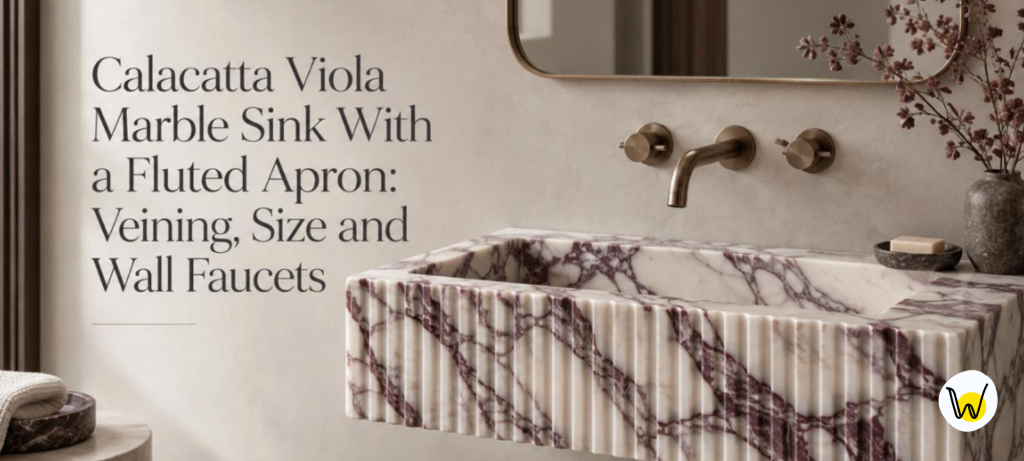
Calacatta Viola is an Italian marble recognized on this HM Marble model by a white field crossed with violet and burgundy veining. In this wall-mounted design, the stone is paired with a vertically fluted apron, a compact 30-inch width and a faucet-free deck intended for fixtures that come directly out of the wall.
The Calacatta Viola marble sink shown by HM Marble measures 30 inches wide, 16 inches deep and 10 inches high. The product page also lists the metric dimensions as 76 cm wide, 40 cm deep and 25 cm high. Its combination of wall mounting, no faucet holes and a sculpted front makes the installation layout part of the design rather than something decided after the sink is selected.
What defines this 30 by 16 by 10 inch model?
The proportions can suit smaller bathrooms and powder rooms where a full vanity cabinet may feel visually heavy. Because the sink is wall mounted, the floor remains visible below it. HM Marble specifies hidden brackets for a floating effect, so the support system is intended to sit behind the stone rather than become a decorative element.
| Feature | Product specification |
| Material | 100% natural Italian Calacatta Viola marble |
| Size | 30 in W × 16 in D × 10 in H |
| Metric size | 76 cm W × 40 cm D × 25 cm H |
| Front design | Vertical fluted apron detailing |
| Faucet holes | None |
| Faucet arrangement | Designed for wall-mounted faucets |
| Backsplash | Optional upon request |
| Finish | Honed and sealed |
How do the fluted apron and veining work together?
The front apron uses repeated vertical channels to give the sink an architectural face. That geometry differs from the movement of the stone itself. Calacatta Viola on this product is described with violet and burgundy veining over a white background, so the finished piece combines regular fluting with the irregular patterning of natural marble.
Because marble is natural stone, the exact line of every vein varies. That matters on a sink with a broad visible front, where both the top and apron become part of the room’s focal point. In a powder room, the basin can therefore act as a substantial stone feature without adding a cabinet below it.
Why does the faucet layout matter?
This model has no faucet holes in the stone. HM Marble states that it is designed for wall-mounted faucets, which means the faucet body and water outlets need to be planned at the wall rather than through the basin deck. That decision affects rough-in positioning, spout reach and the relationship between the outlet and the bowl.
A wall faucet also leaves more of the marble top visible. The trade-off is that plumbing positions need to be coordinated before installation. If the outlet sits too far back, too high or too short for the basin geometry, the finished setup may be awkward even when the sink itself is mounted correctly.
Where does this sink fit best?
The product page identifies smaller bathrooms and powder rooms as suitable settings for the 30-inch format. Those rooms can benefit from a wall-mounted fixture because the open space below the basin reduces visual bulk. The fluted front also gives the sink a defined facade without relying on a conventional vanity cabinet for visual interest.
It can also suit projects where the faucet is already intended to come from the wall. In that situation, the absence of faucet holes is part of the design logic. A project that requires deck-mounted taps would need a different drilling configuration or a customized version rather than assuming holes are included.
What should be planned before installation?
Three points deserve attention before installation: structural support, faucet position and surrounding clearances. HM Marble lists hidden brackets as the mounting method, so the wall structure must be appropriate for the bracket system and the weight of a natural stone fixture. Final support details should be coordinated with the installer responsible for the site.
The wall faucet should be positioned with the actual sink dimensions in mind, especially the 16-inch depth. The optional backsplash should also be decided early because it changes the relationship between the sink and finished wall surface. In a tight powder room, door swing and circulation space should be checked against the 30-inch width rather than judged from photos alone.
How does HM Marble make this type of sink?
HM Marble produces natural marble and travertine sinks in Afyonkarahisar in Türkiye’s marble region. The brand describes its process as starting with CNC cutting and continuing with hand finishing, with sinks carved from single blocks of stone. In the United States, sales are handled through HM Marble LLC.
For this model, the main decision is whether the violet and burgundy veining, fluted apron, 30-inch scale and wall-faucet layout suit the room being designed. Considering those elements together helps the handcrafted marble sink function as a coordinated architectural component rather than an isolated fixture.

