
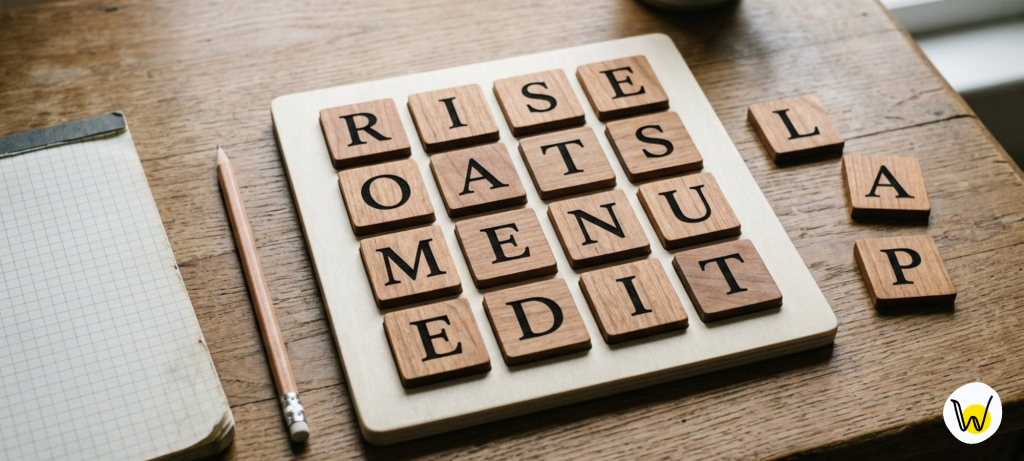
Tessera puzzle is a daily word game with an unusual twist: nothing is hidden. You get a 4×4 grid of letter tiles, every letter you need is already on the board, and you swap tiles until each row spells a word and each column does too. The official site says everyone gets the same puzzle every day, which makes it easy to compare how you did with friends. If Wordle left you wanting something more spatial, this is worth a try.
What Is Tessera Puzzle?
Tessera puzzle is a browser-based daily word puzzle made by an independent developer, and it also has an iPhone app. The idea is simple to state. Rows and columns both have to be valid words, so every tile you move has to work in two directions at once. The name fits, since a tessera is one of the small square tiles in a mosaic.
Be careful with the name, though. Searching for it brings up a mobile art-puzzle game, a block puzzle, a logic app and a multilingual crossword, and none of them is the same game. This article is about the daily word grid you can play on the official Tessera Puzzle website.
Compared with most daily word games, the thinking here is different. There’s no secret word and no limited number of guesses. You’re rearranging letters you can already see, a bit like an anagram puzzle crossed with a sliding puzzle. That makes Tessera a good example of constraint-based word games, where every move has to satisfy several rules at once.
How to Play Tessera Puzzle Online
The rules are simple, but finding the right arrangement can take time. Here’s how a typical game goes.
Start by reading the board
The classic grid has sixteen tiles. It’s tempting to start swapping immediately, but a few seconds of looking helps. Count the vowels, spot any awkward letters like K, W or Z, and notice doubled letters. If the board only has two vowels, you already know the words will be heavy on consonants, and that narrows your options fast.
Swap two tiles at a time
Each move exchanges two tiles, and that’s the only action in the game. One swap changes a row and a column for each tile involved, so a move that fixes one word can easily break two others. Learning to spot that before you tap is most of the skill.
Use the board’s feedback
The maker has said the game gives a gentle “you’re warmer than you think” signal rather than confirming a tile is in its final spot. Exactly how that looks on screen is worth checking when you play, since the visuals may change over time.
Aim for fewer swaps
Finishing the grid is the first goal. Finishing it in fewer swaps is what keeps people coming back once the basic puzzle feels comfortable.
Tessera Puzzle Rules Explained
The rules fit in one line: arrange the tiles so every row and every column forms a valid word. Most beginners stumble on the “every column” part. Building four neat words across feels like progress, but those words also have to line up so the letters read correctly downward.
The grid below is a practice example I built to show the idea. It’s a deliberately constructed word square, not an actual daily solution.
| 1 | 2 | 3 | 4 | |
|---|---|---|---|---|
| Row 1 | T | E | A | M |
| Row 2 | E | A | S | E |
| Row 3 | A | S | K | S |
| Row 4 | M | E | S | S |
Read across and you get TEAM, EASE, ASKS and MESS. Read down and you get the same four words. That symmetry is unusual, since real puzzles normally have different words in each direction, but it shows how tight the grid is. Every letter does a job in two words.
Imagine being handed those sixteen letters in a jumble. You’d have to find this arrangement through swaps alone. Corner tiles belong to only one row and one column, while the interior tiles carry more weight, so it often pays to settle the middle first.
Tessera Classic vs Hard Mode
The standard daily puzzle uses the 4×4 grid, and it’s the sensible place to start. Sixteen tiles and eight words (four across, four down) is a manageable amount to hold in your head.
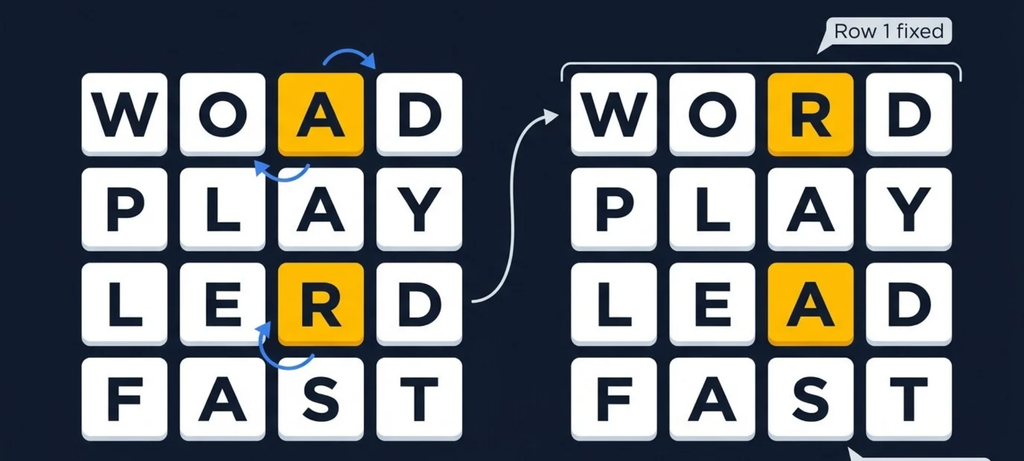
Hard mode moves to a 5×5 grid, which the site describes as the harder daily version. Twenty-five tiles means more letters to place and more arrangements to consider. Five-letter words also give you more believable-but-wrong options, so a wrong turn is easier to take.
My suggestion is to treat Classic as the warm-up and Hard as the main challenge once the smaller grid stops giving you trouble. That’s just a preference, not a rule. Some players find the bigger board easier to read and go straight to it, and there’s nothing stopping you from playing both on the same day.
How to Solve Tessera Puzzle More Efficiently
A good daily word game strategy mindset helps in general, but a few habits are specific to this game.
Build around the awkward letters
If the grid has a Q, J or Z, you have very little freedom with it. Place that letter first and the surrounding tiles often settle themselves, because only a handful of words can contain it.
Look for letter pairs that belong together
Common starts like ST, TR and CH, and common endings like ES, ER and ED, are easy to spot once you’re looking for them. When two tiles obviously sit side by side, hold onto that idea and build outward from it.
Check rows and columns before every swap
Before you tap, ask what the move does to the row and to the column for both tiles. Swaps that fix one word while damaging two more are the quickest way to waste moves.
Stop swapping at random
Random swaps feel productive, but they undo progress you’ve already made. If you’re stuck, pause and read the grid down the columns instead of across the rows. A different angle often shows you what was hiding.
Review your swaps afterwards
When you finish, think back over which moves didn’t help. Reviewing them can make the next grid quicker to solve.
Tessera Puzzle vs Wordle and Other Daily Games
Tessera puzzle sits in the same family as Wordle, since it’s daily, quick and shared by everyone, but the actual thinking is quite different. Wordle asks you to deduce a hidden word from feedback on your guesses. Connections asks you to sort words into hidden categories. Tessera hands you every letter and asks you to fit them into a grid that works in two directions.
If Wordle feels like detective work, Tessera feels more like carpentry. You already have the materials, and the job is fitting them together without leaving a gap. Anyone who likes anagrams or crosswords will probably settle in quickly.
Frequently Asked Questions
What is Tessera puzzle?
It’s a daily word game played on a grid of letter tiles. You swap tiles until every row and column spells a word. The classic version uses a 4×4 board.
How do you play Tessera puzzle?
Pick two tiles to swap their positions, and keep going until all rows and columns form words. Check both directions before each move, because every swap affects two words per tile.
Where can I play Tessera puzzle online?
You can play in your browser on the official site at tesserapuzzle.com. There’s also an iPhone app if you prefer playing on your phone.
What is the difference between Tessera Classic and Hard?
Classic uses a 4×4 grid, while Hard uses a larger 5×5 grid. The bigger board has more tiles and more arrangements to work through.
Does Tessera have a new puzzle every day?
Yes. It’s a daily word puzzle, and the site says everyone gets the same one each day.
Is Tessera puzzle similar to Wordle?
Only in format. Both are daily and quick, but Wordle is about guessing a hidden word, while Tessera is about rearranging visible letters into a valid grid.
How can I solve Tessera in fewer moves?
Plan each swap before you make it, build around awkward letters first, and avoid moves that fix one word while breaking others.
Final Thoughts
Tessera has a simple rule, but satisfying it in every row and column takes careful planning. Start with the 4×4 Classic grid, get into the habit of checking both directions before each swap, and move up to 5×5 Hard when the smaller board stops pushing back. When you’re ready to try today’s grid, the official Tessera Puzzle site is the place to start.

